
One of the most common questions I hear from business owners in our community is:
“Why is Stripe asking for my Social Security Number (SSN)? Are they pulling my credit?”
The same question pops up when people open a bank account online with Chase or apply for financing. Many automatically assume that providing their SSN means a credit check—but that’s not always the case.
Let’s break this down and clear up the confusion.
1. Context Matters:
EIN Applications & Corporate Officers
When you applied for your Employer Identification Number (EIN), the IRS asked for the responsible party’s Social Security Number right at the start of the identity section.

Why? Because the IRS needs to verify the identity of the corporate officer who can legally bind the corporation.
👉 A corporate officer is not the “owner.” They’re simply a representative (president, CEO, treasurer, etc.) who has the authority to sign and act on behalf of the company.


This shows us something important: your SSN is not being used to check your credit—it’s being used to confirm you are who you say you are.
2. Stripe Capital Loan Applications
When you apply for a Stripe Capital loan, the system prompts you for your SSN or ITIN. The wording is clear:
“To verify your identity, we’ll need your full SSN/ITIN. We are required to collect this information to satisfy regulatory obligations.”
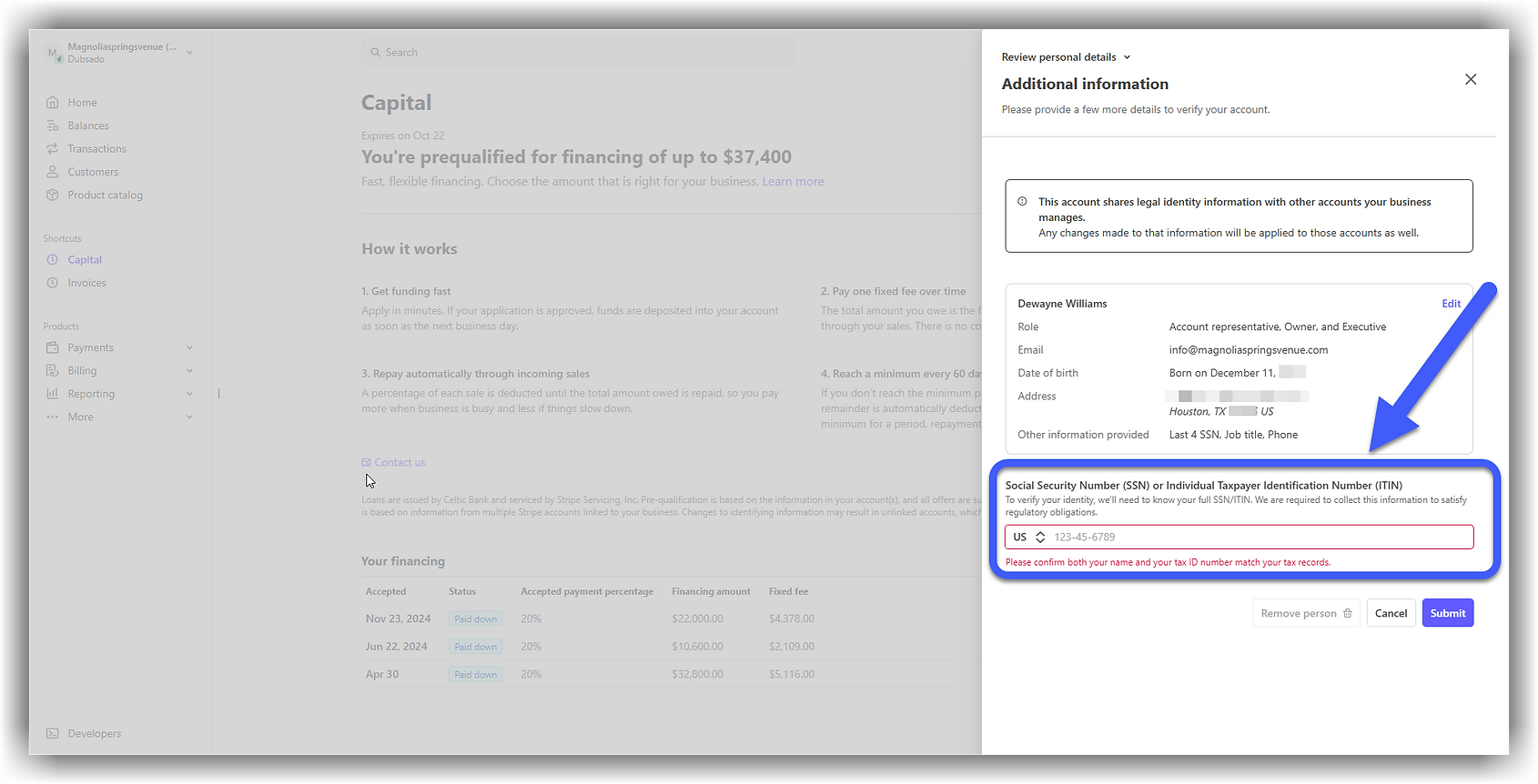
Stripe isn’t looking at your credit score. Instead, they’re:
- Matching your name, date of birth, and SSN against government and financial databases.
- Confirming the identity of the person signing on behalf of the corporation.
- Ensuring compliance with federal banking regulations.
This is identity verification, not a personal credit check.
And once that step is complete, Stripe can generate real offers based on your business activity.

3. Chase Bank & Consumer Reports
When opening a Chase account online, you’ll notice two key authorizations:
A. Social Security Verification
Chase works with the Social Security Administration (SSA) to confirm that your name, SSN, and date of birth match official records.

B. Consumer Report Authorization
This is often confused with a credit check.
But a consumer report is broader—it includes information from databases used to verify identity, prevent fraud, and confirm your financial profile.

💡 Definitions you need to know:
- Consumer Report – A report containing information about your identity, character, reputation, personal characteristics, or mode of living (per the Fair Credit Reporting Act).
- Credit Report – A specific type of consumer report focused on your credit history and score.
So when Chase asks for a consumer report, it’s often about verifying identity and risk, not dinging your credit score.
4. Why the Confusion Happens
Here’s the missing piece:
When you apply online (whether it’s for Stripe or Chase), you are talking to a computer, not a person.
The system must validate your information automatically by cross-checking it with multiple databases. That’s why you see warnings like:

“By choosing ‘Next,’ you verify that all of the information you’ve given us is correct.”
The computer is not pulling your personal FICO score—it’s simply making sure your name, SSN, and other details match what’s already on file.
5. The Big Takeaway
When you’re asked for your SSN in these situations, it’s not about making you “personally responsible” for the loan or account. It’s about identity verification and compliance.
- IRS EIN application – SSN verifies the responsible party.
- Stripe Capital – SSN verifies the identity of the person binding the corporation.
- Chase Bank – SSN verifies your information against SSA and consumer databases.
🔑 Impactful truth: Providing your SSN doesn’t always equal a credit check. Sometimes, it’s simply the key to proving you are authorized to act on behalf of your business.
Final Word
The next time you’re asked for your Social Security Number, pause and read the language carefully. Ask yourself:
- Does it say “verify your identity”?
- Does it mention “regulatory obligations”?
- Does it state “no impact to your credit score”?
If yes, you’re not dealing with a credit check—you’re dealing with an identity verification process.
And that context can make all the difference.


